Wow there are so many scientists and smart people here, i wonder why you guys got stucked playing an online game? serious question !!! I quitted a few months ago to be able to focus on my civil engineering degree and i realised i could read something that makes me smart instead of wasting my freetime playing game ...
How many of us do you think still have the time to play?
How many of us do you think still have the time to play?
I guess everyone who's active on this forum ? I still visit it once in a while because i spent 2 years playing FFXI and i care about how the game's doing and stuff ^^. This time i spotted a very interesting topic about planet and light speed and etc. and am amazed that some people can explain stuff better than my old teacher. So i'm just wondering hehe
Wow there are so many scientists and smart people here, i wonder why you guys got stucked playing an online game? serious question !!! I quitted a few months ago to be able to focus on my civil engineering degree and i realised i could read something that makes me smart instead of wasting my freetime playing game ...
There ARE many intelligent people on these forums, but the discussions in this thread are really all just laymen's physics (not to sound condescending, because I don't know anything about physics myself). The dedication and work scientists put in has way, way more complexity.
You don't always have to comprehend all the smallest details to understand the big picture.
According to the video I posted earlier: "According to relativity theory, this observer sees the pulse moving through space at exactly the same speed as the pilot does, namely the speed of light". I don't have to know -exactly- why relativity theory says that (which I in fact do understand) or the mathematical models behind why that's true (which I don't understand/remember as much); and not perhaps something like the observer sees a different speed but the same distance.
I can still accept that as being a true tenant of relativity theory, and from that understand the concept of time dilation.
Sometimes, the most beautiful things are the most simplistic in formulatic expression.
I think (leyman's)theoretical physics is fascinating, but yeah, those 10+ variable formulas are completely over my head. >_> I wouldn't call that "simplistic" at all.
If that all actually makes sense to you, then maybe you really should be pursuing a career in a field of science....
Joining in on the epicosity here. Had a question..I don't remember where I saw it but a looong while back I remember seeing a diagram or animation that said if any ship/object WERE to be able to travel at the speed of light, that its mass would have to increase gigantically as it approached the speed of light?
Not the exact wording but it was something like that. Jaerkin, Eugene, care to help me out here? D:
BUMP for positivity and the proliferation of humans!
If I have to read one more thread title that involves an apocalyptic scenario, I'm going to drive down Mo-Pac to the Guns N' Ammo store, buy a sword, dowse it in na-palm, then drive thirty miles outside of Austin and steal a horse. I figure I can recruit three other horsemen/women on the way. If no one else will, I'll get this mother started!
BUMP for positivity and the proliferation of humans!
If I have to read one more thread title that involves an apocalyptic scenario, I'm going to drive down Mo-Pac to the Guns N' Ammo store, buy a sword, dowse it in na-palm, then drive thirty miles outside of Austin and steal a horse. I figure I can recruit three other horsemen/women on the way. If no one else will, I'll get this mother started!
Famine should be easy. Hit up a bulemic's rehab center.
Warning: I'm pretty sure that everything in this post is incorrect, but it's how I've always viewed light travel, so I wanna post it anyway!
Cerberus.Eugene said:
According to the video I posted earlier: "According to relativity theory, this observer sees the pulse moving through space at exactly the same speed as the pilot does, namely the speed of light".
I have an issue with that video, I didn't say anything because you and Jaerik had already explained why my issue was wrong before I saw it, but I'll explain it anyway.
It basically relates to the whole "headlights on a ship moving at the speed of light" problem. I was never aware of this squashy/stretchy time relativity thing, and always assumed that the speed of light was an absolute constant. This would mean that you can't propel light, and the speed at which it escapes your headlights is independent from the speed at which your headlights are travelling. So if you were to travel at the speed of light, all the light you are emitting (not just from your headlights, but light that is reflected off the rest of your ship) would be travelling at the same speed as you are. So maybe travelling at the speed of light would actually cancel out your frontal light emissions, or maybe all your light emissions would be compacted and travel along with you, to be sort of "released" in a ridiculously bright flash of light when you exit light speed.
The problem this theory represents for that video, is that the laser fired from ship A to ship B would simply miss the mirror. Since the light of the laser would travel in the exact direction the laser gun "fired" it, rather than being influenced by the relative speed of the gun, by the time the laser got to the mirror on ship B, ship B would have moved forward by the same distance as the gap between the gun and the mirror.
The other thing this theory of mine involves is what people witness in regards to light speed travel. If you're on a ship travelling at light speed headed in a straight line towards planet Fred, which is one light year away, what you would see at the start of your journey is what happened on planet Fred one year ago, since that's how long it takes for the light emitted by planet Fred to reach your eyes. However, as you travel for one year towards Fred, by the end of the journey, you'll be seeing what's happening on Fred in the present day. This means that if you were to view Fred through a telescope from your ship throughout your entire year long voyage, that time on Fred would move at double time from your perspective. This would be easily explained by the fact that you're travelling towards Fred at light speed, but the light from Fred is also travelling towards YOU at light speed, hence you'd be copping it twice as fast.
Now someone on Fred watching your journey through a telescope would see your entire journey instantaneously, since the light you emit when you depart would take a year to reach Fred, and you would ALSO take a year to reach Fred, they'd see the whole journey at once. You'd probably also obliterate the entire planet by exposing it to a years worth of your reflected light at once.
On the other hand, someone back on Earth watching you go to Fred would have to keep watch for TWO years to see your entire journey, and they'd be seeing it at half speed. When you were halfway there, the light you emit would take half a year to get back to Earth, and you've already been travelling for half a year etc.
The thing is though, even taking relativity into account, I don't see how what I've always thought would change for the people on either of the two planets. For the people on the ship, if time slows down, it would apparently seems like a lot less than 1 year for them, which means to their point of view, Fred would be moving at an even faster rate than double speed, but if it's taken one year according to someone on Fred or Earth, yet only half a year according to the people on the spaceship, then what do people on either planet see? Would travelling AT light speed actually pause time altogether for those on the ship, so they'd witness exactly what the people on Fred witnessed, an instant voyage? In a way that kind of makes sense, since otherwise you'd be squashing light by emitting it at the same speed as you were travelling.
Speed of light isn't a constant. Speed of light in a vacuum maybe, but light slows down in any medium. That's why if you take a pen and put it in a clear glass filled with water it looks as if the pen bends. Light from the air transmits the picture of the pen to you at one speed, and in water light is further slowed and bends even more, making the pen appear as if it's bent.
The question you have about the light fired from the ship is slightly different though because it assumes no medium.
The pulse as observed from from the space ship has travels along 2 axes. The vertical axis from ship to ship(moving the speed of light), and the horizontal access (moving nearly the speed of light).
The reason it appears straight from the observer on the ship is because the observer from the ship has the same horizontal velocity that the light beam does, so it appears to the observer aboard the ship that the light only moves vertically.
You can see the two components of the velocity as the observer from the asteroid. Because the observer on the asteroid is stationary, or stationary relative to the spaceships, he can observe the horizontal component of the light travel.
Because he can observe the light traveling along a horizontal as well as a vertical component he sees the light traveling at a greater distance compared to what the observer on the spaceship sees. Since speed is distance/time and speed is constant, if distance changes then time must change as well to keep speed constant.
Speed of light isn't a constant. Speed of light in a vacuum maybe, but light slows down in any medium. That's why if you take a pen and put it in a clear glass filled with water it looks as if the pen bends. Light from the air transmits the picture of the pen to you at one speed, and in water light is further slowed and bends even more, making the pen appear as if it's bent.
The question you have about the light fired from the ship is slightly different though because it assumes no medium.
The pulse as observed from from the space ship has travels along 2 axes. The vertical axis from ship to ship(moving the speed of light), and the horizontal access (moving nearly the speed of light).
The reason it appears straight from the observer on the ship is because the observer from the ship has the same horizontal velocity that the light beam does, so it appears to the observer aboard the ship that the light only moves vertically.
You can see the two components of the velocity as the observer from the asteroid. Because the observer on the asteroid is stationary, or stationary relative to the spaceships, he can observe the horizontal component of the light travel.
Because he can observe the light traveling along a horizontal as well as a vertical component he sees the light traveling at a greater distance compared to what the observer on the spaceship sees. Since speed is distance/time and speed is constant, if distance changes then time must change as well to keep speed constant.
The thing is though, I totally understand that concept if it were say, throwing a tennis ball from a car and bouncing it off another car and catching it again. From your perspective, you've thrown it a meter or two straight at the other car (ignoring wind resistance here), watched it bounce and caught it again. Yet the dude watching from the overpass has seen it travel much more than just that two or so meters due to the distance the cars and ball have travelled in the time it takes for the ball to complete it's journey. However, this means that the ball is actually travelling faster than the car. I know light can be slowed down, but wasn't aware that it could also be sped up.
Anyway, I made a quick video to visually represent my previous post :o Just think of the coloured dots as emitted light from their respective objects.
I think I know where you are going. In order to see it you need to see the light projected from the laser, ships, etc to perceive it? Or are you talking about the object itself?
I think I know where you are going. In order to see it you need to see the light projected from the laser, ships, etc to perceive it? Or are you talking about the object itself?
Not just in order to see it, but say the ships are travelling at the speed of light, in order for the laser beam to complete it's journey from one ship to another, it would actually have to travel faster than the speed of light. It relates to that age old question "If you were on a ship moving at the speed of light, and you moved from the back of the ship to the front, wouldn't you be travelling faster than the speed of light?"
I still don't understand how that question isn't accurate, assuming we can make something travel through space at almost the speed of light, what's stopping us from propelling something forwards from the ship, or travelling forward within the ship? From my understanding before reading this thread, it would make sense that if you were standing in the middle of the ship, you'd be able to see the front of the room, but not the back of it, because you're moving away from the light emitted by the back of the room at the same speed as it's emitting it.
I reread what you said and I think I understand the confusion. The laser never actually breaks the speed of light. It's just traveling the speed of light along 2 axes. It's traveling the speed of light along the horizontal axis because that's the speed it was traveling horizontally when it was fired vertically. It's traveling the speed of light along the vertical axis because that's the speed at which lasers travel. If you fired a laser from the front of the ship that's moving the speed of light from the front of the ship the going the speed of light it wouldn't go anywhere because the laser is already moving horizontally at maximum velocity.
Edit: my explanation of the frontal firing laser is a little clumsy, someone may want to correct me on that.
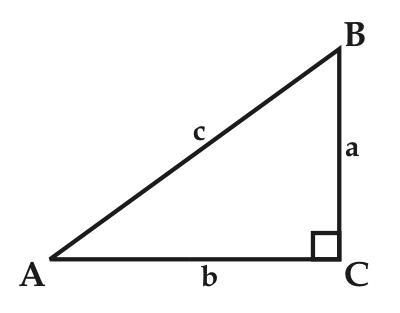
That doesn't make sense though, think of it from a geometry perspective. You're looking at a right angle triangle.
Side a is the distance between the two ships, side b is how far they both travel in the time it takes for the laser to make it's one way journey, and side c is how far the laser beam would actually have to travel to make contact with the mirror.
If it takes 1 second for light to travel the distance of a, then that's also how far the ships will travel in one second, so a and b are the same distance. So because of all that, the laser beam has to travel path c, which is a greater distance, but still only has 1 second to do it in. The only way you can travel a greater distance in the same amount of time is by going faster.
It also doesn't matter if they're not actually travelling at the speed of light, but merely close to it, the issue would be the same. In fact, the issue would be the same even if you did the experiment off the backs of snails, but because of the speed of light relative to the speed of the snails, it would be such an imperceptible difference as to not matter.
I'm trying to be difficult here by the way, this is actually the sort of ***I think about <_<
Sigh you're making me think about this way too late. lol
If I had to guess right this minute it has something to do with the fact that you're still only looking at component parts of added vectors. You're still only moving c along x-axis and and c along the y axis. The vector is still moving c along the x axis regardless of the speed it's traveling along the y axis
If you're moving through a vacuum at velocity c and you release a ball out the window of the spacecraft it will float there along the side of the ship at the same speed because no force is acting on it.
It doesn't matter if you drop the ball outside the window, or throw the ball with velocity p perpendicularly to the spaceship, the ball will still be moving in the direction of the spaceship at velocity c.
My best guess at 4am is that you're losing information when you add vectors. The fact that at the speed of light the vector appears to be saying it's moving diagonally at a rate faster than the speed of light is simply because you lost information by adding the vectors, namely the original directions of the velocities. The resulting vector can appear to say that the velocity along the diagonal is greater than the speed of light when in reality it's just the sum of two velocities that are less than or equal to the speed of the light.
If someone can explain why what I'm saying is wrong or provide a better explanation than my 4am shot, by all means please do :)
I understand what your problem is now, but it's almost 4am and I can't remember vector addition that I did 5 years ago. Hopefully someone will be able to answer your question before tomorrow morning, but if not I'll take another look at it.
Oh pish, I'm totally fine with not knowing the answer. If I did know the answer, as is the way with science, it'd just open up more questions that I also didn't know the answer to *shrug*
I've just tried to explain how I've always seen it and stuff, if that invokes some thought and discussion, then all the better, but I'm not overly bothered if no-one can answer it, I'm on a forum for an MMO, not astrophysics :p
Magnetic propulsion/levitation wins, for anyone who picked up on the Plasma Engine comment earlier, or is interested in the potential developments of space travel.
The thing is though, even taking relativity into account, I don't see how what I've always thought would change for the people on either of the two planets. For the people on the ship, if time slows down, it would apparently seems like a lot less than 1 year for them, which means to their point of view, Fred would be moving at an even faster rate than double speed, but if it's taken one year according to someone on Fred or Earth, yet only half a year according to the people on the spaceship, then what do people on either planet see? Would travelling AT light speed actually pause time altogether for those on the ship, so they'd witness exactly what the people on Fred witnessed, an instant voyage?
Here we're assuming that something massive (compared to photons) can in fact travel at light speed. There are difficulties with such a view, but we'll use it anyway and I'll try to explain away your difficulties with this hypothetical picture.
For the people on Fred, they'd observe an instantaneous voyage, yes - as you rightly said, all your reflected/emitted light from the entire journey is going to arrive at Fred at the same time, if we neglect time-dilation effects.
Now, light adds logarithmically (as sound - if you've got one stereo playing at 10dB and another at 10dB you DON'T get 20dB of sound, more like 10.8dB), so you don't destroy Fred with your light-blast - the picture given in Star Trek when looking axially at a starship exiting warp speed (with a bright-ish flash then normal view) is probably quite accurate.
On Earth, they'd see you leave when you left, and arrive at Fred 2 years later, understandably.
On the ship, you'd see the events on Fred at double-time, until you popped out of light-speed.
If you looked out your rear window, everything on Earth would be standing still, as the same light you saw when leaving would chase you the whole way. Practically, the spot exactly behind you would appear black as there would be no light reaching you from there whatsoever - it would chase your retinas but never quite reach them.
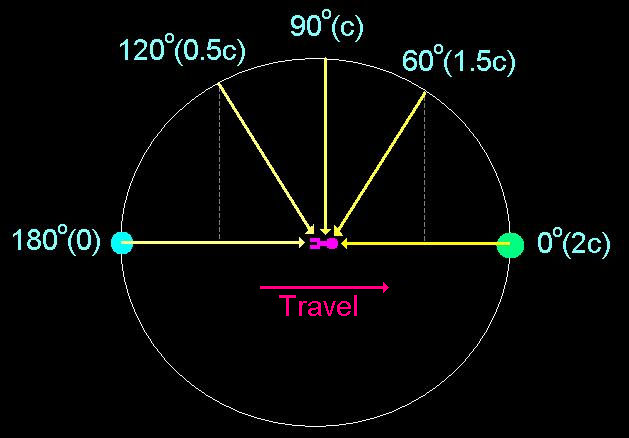
In an arc around you you'd have differing apparent speeds of events, see the chart I drew up.
The values shown are the relative speeds of light reaching you. You'd see events at 90° occurring at the correct speed, events at 60° at one and a half times the correct speed, events at 120° at half the correct speed etc. Inside the ship, you'd be travelling for a year (if you had a standard clock on board), and if you had no windows you'd know nothing different. If you were watching Fred it'd seem like it took you two years to arrive (you've seen two Fred-years go by since you started your voyage), etc.
Issues with this picture arise when you realise that if something travels at light speed, and has mass, everything else gets messed up. That's why (in the in-ship frame of reference) it'd only appear to take 17 days (or something equally stupid from a classical viewpoint) to arrive at Fred, due to relativity - it just doesn't work if you consider it using classical mechanics.
The situation for the people on each planet, however, remains as described above. Relativity only messes stuff up for the people on the ship.
Okay that all makes sense, and the part about light adding together the same as sound is... comforting? I guess? You know, if I was worried about someone inventing light speed travel and accidently exploding the planet or something? lol
CeeJaii said:
That's why (in the in-ship frame of reference) it'd only appear to take 17 days (or something equally stupid from a classical viewpoint) to arrive at Fred, due to relativity - it just doesn't work if you consider it using classical mechanics.
The situation for the people on each planet, however, remains as described above. Relativity only messes stuff up for the people on the ship.
The one thing I didn't cover though is about how one year gets condensed into 17 days (or whatever it is). The people on Fred would see the voyage instantaneously, so it wouldn't make a difference to them, but what would the people on Earth see? Your ship, according to Earth, is emitting 17 days worth of light over the space of a whole year. If you had a big clock on the back of your ship, would someone on Earth see that clock as taking 2 years to count up to 17 days?
Oh, and as for your chart, wouldn't you have to count time dilation into that as well? So you'd see Fred at double speed, PLUS your time dilation, so you'd actually be seeing 2 years worth of activity in 17 days. That'd be a hell of a trip lol.
The guys on Earth would see your journey taking two years, but yeah, a clock stuck on the back of your ship would only revolve (days of journey apparent to shipmates) x 2 times, so Earth'd see a REALLY slowly moving clock.
That'd be about right for your in-ship observations, too. From Fred, you'd observe two whole "years" of events, but it would arrive at the ship spread out over however long the journey appears to take on-board, so it'd be super-fast. 'cos people don't really understand anything about time-dilation, it could be that you see a little segment at double-time as per the above, then skip a huge chunk, then another segment.
It could also be that the act of observing Fred forces your apparent journey length up. Like, if you're not watching Fred, you move at your 17 days rate, but if you watch it for a month straight, you see two months worth of activity and your journey is extended. The uncertainty principle means weird things happen if you're watching, much like the old "if a tree falls and no-one's around to hear it..." question.
Of course, having a window on the ship and giving in to the urge to watch could just make this happen:
It's why science is just theory until we give it a go and see what actually happens. Experimentation is the most enjoyable part, 'cos you usually witness something totally unexpected.
Twenty Light-years away, a veritable "Stone's throw" in an astronomical sense, lies Gliese 581, and the fourth planet, dubbed Gliese 581d (They're astronomers, not writers) is (one of several actually, but this is the interesting one) a planet that falls into the habitable zone for it's star.
FrenchAstronmers said:
"With a dense carbon dioxide atmosphere - a likely scenario on such a large planet - the climate of Gliese 581d is not only stable against collapse but warm enough to have oceans, clouds and rainfall,"
Gliese 581d is believed to have a mass around 7times that of Earth, but a lower rotational velocity results in a gravity of about twice that of Earth.
FrenchAstronmers said:
"The denser air and thick clouds would keep the surface in a perpetual murky red twilight, and its large mass means that surface gravity would be around double that on Earth,"
Two things strike me as peculiar, first has already been said, this Planet is actually very close to us. While it would still take 300,000Years to arrive using conventional propulsion, on a cosmic scale, it might as well be down the block.
Second, Gliese581(The star) is a Red Dwarf (Tiny, with low output), Red Dwarf stars are not exactly the powerhouse of fusion our Star is, it was originally thought that the likeihood of planets forming within a Red Dwarfs theoretical habitation zone was beyond unlikely, and damn near impossible, once again showing the world, that when dealing with things on a galactic scale, there's no such thing as a statistical impossibility.
It's just a shame Obama pretty much shut down our space program.